
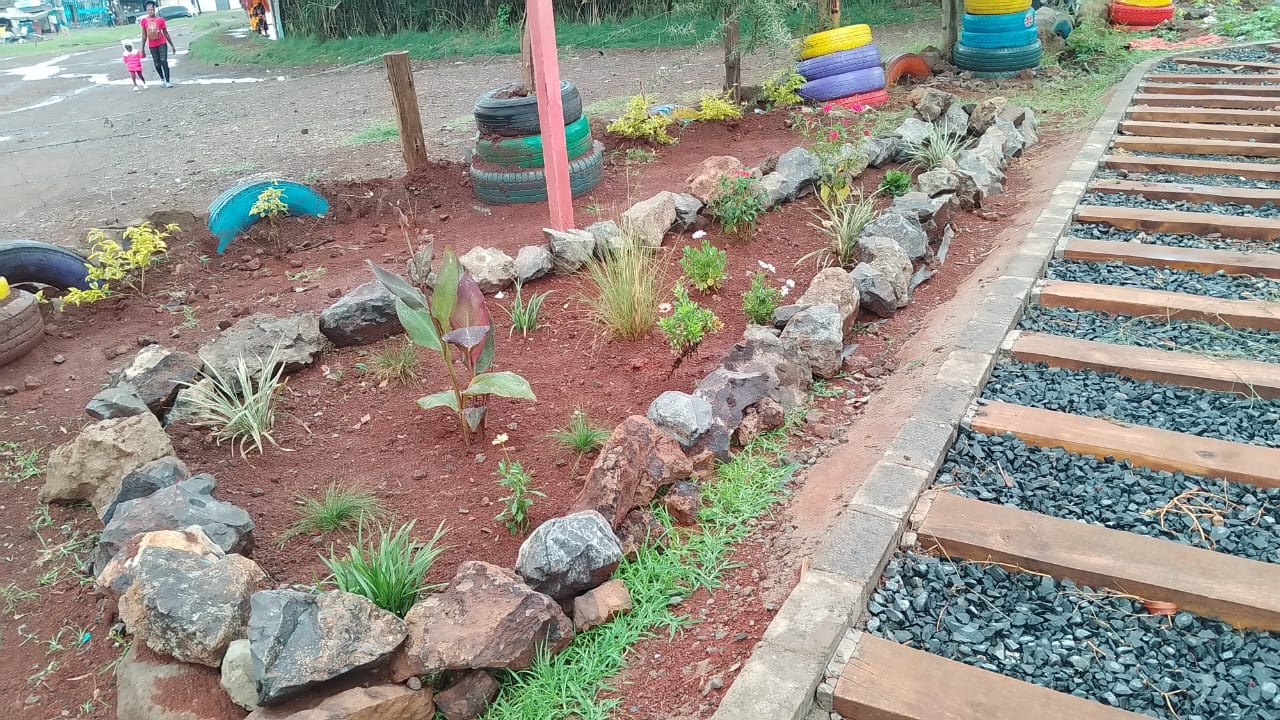


At Dandora Community Park, a new feature has recently been completed.
It doesn’t stand out immediately.
There are no bright colours.
No obvious structures.
Just a slightly lowered, planted area integrated into the landscape. But that space is doing something important.
It is a rain garden.
It is designed to collect water from the roof of the mental health corner once construction is complete. But even before that connection is finalised, the system is already in place. And that matters. Because managing water in a space does not start when problems appear.
It starts with how the space is designed from the beginning.
When rain falls on hard surfaces (roofs, pavements, compacted ground) the water has to go somewhere.
If it moves too quickly, it can overwhelm drainage systems.
If it is not directed properly, it can lead to flooding, erosion, or damage to the space itself.
A rain garden changes that.
Instead of letting water rush across the surface, it slows it down. It allows water to collect, soak into the ground, and filter naturally through soil and vegetation. This reduces pressure on drainage systems. It also protects the surrounding area from water damage over time. In Dandora Community Park, this is part of how the space is being designed to function long-term.
Not just as a place people use. But as a space that can respond to environmental conditions.
Because climate resilience in cities is often built through small, deliberate systems like this. Not always through large infrastructure. But through features that manage water where it falls. And while this example is in Dandora, the principle is not limited to one location.
Spaces across Nairobi face similar challenges:
Heavy rainfall.
Increasing hard surfaces.
Limited drainage capacity.
Integrating systems like rain gardens into public spaces, schools and community areas is one way cities can respond.
It is a simple idea. But when applied consistently, it changes how spaces perform over time. We continue documenting how public spaces across Nairobi are being designed to manage water, reduce flooding risk, and support long-term resilience.
Follow our work to see how these systems are being implemented in practice:
Instagram: [ https://www.instagram.com/publicspacenetwork/ ]
LinkedIn: [ https://www.linkedin.com/company/public-space-network/?viewAsMember=true ]
Facebook: [ https://www.facebook.com/PublicSpaceNetwork ]
TikTok: [ https://www.tiktok.com/@publicspacenetwork ]
Because sometimes, the difference between a space that floods and one that holds up… is how water is handled before it becomes a problem.